
Five life lessons from classic children's books
Read books for children! They are so good

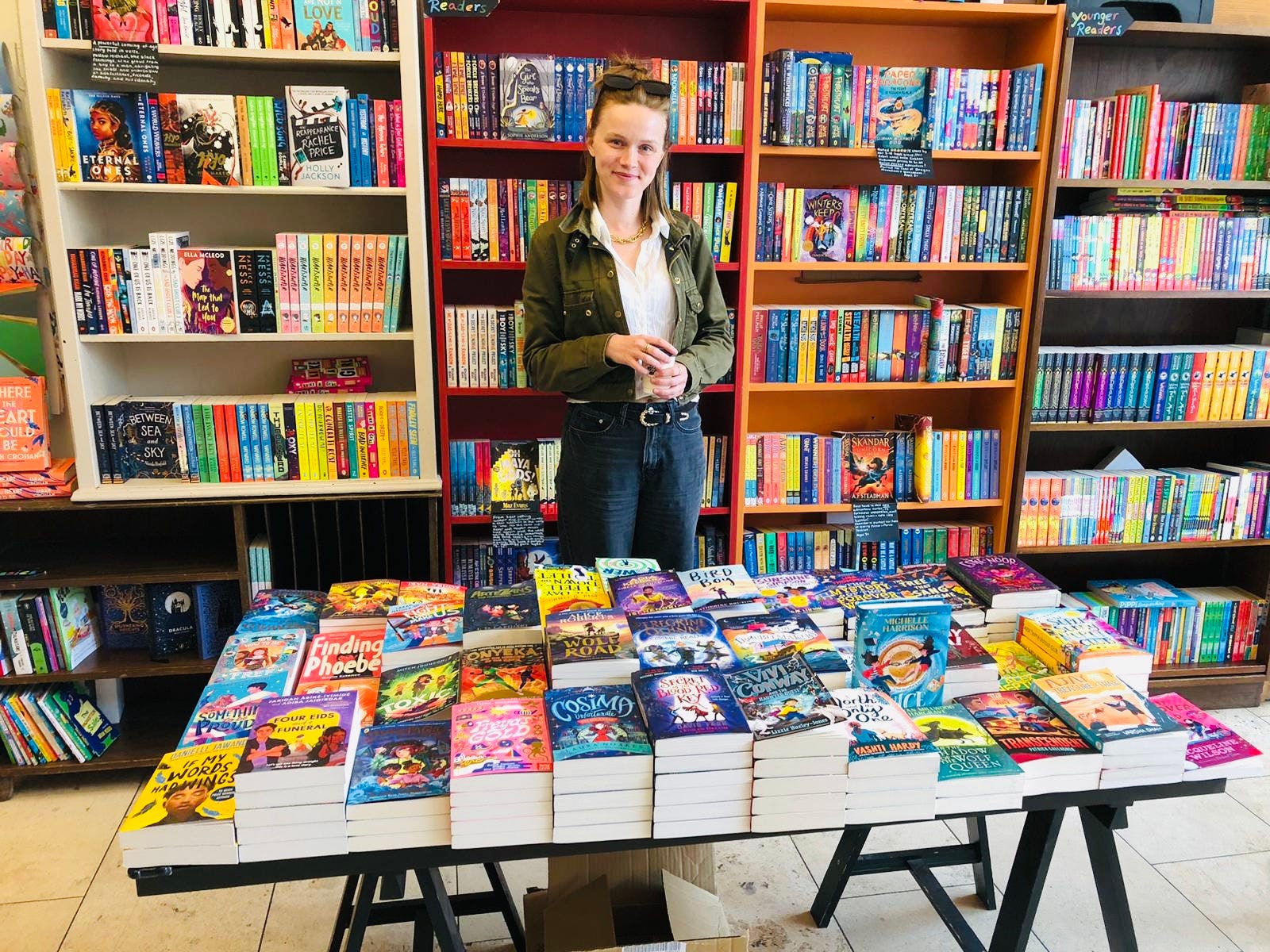
If you haven’t heard of the contemporary children’s author Katherine Rundell, you have been living under a rock. Not only is she the writer of half a dozen award-winning, best-selling, truly exceptional middle-grade books (Rooftoppers; The Good Thieves, Impossible Creatures) she’s also the author of an award-winning biography of the early modern poet John Donne, and she’s a Fellow of All Soul’s (the super elite Oxford college which is even harder to get into than regular Oxford). What I’m saying is, she’s incredibly smart and could write anything she wanted to. But when asked which is more difficult, writing for adults or children, and which she’d choose if she had to pick one, Rundell always answers children to both. There is an Auden line she quotes in explanation:
There are good books which are only for adults, because their comprehension presupposes adult experiences, but there are no good books which are only for children.
In other words, the best children’s books will appeal to us when we are young and forever onwards; so it is the harder skill to master. Rundell also talks about children’s literature as something distilled, rather than reduced; not simpler or lesser than adult fiction, but a crystallised version of everything that is magical and profound about storytelling. I entirely agree. Children’s books, especially the middle-grade novels we read when we are about eight to twelve, are often our first encounter with reading independently. When these books are flimsy or boring or lazily written, you can feel your imagination glazing over, the way it does when you watch too much reality television. I don’t think reading a bad book leads children on to reading a good book. I think it turns them off reading for life. That’s why it’s so depressing to see the market flooded with celebrity ghost-written novels - as if publishing for children is a cash-grab, like starting a hair-care line or selling videos on Cameo. (And if you want to read a rigorous critique of the vapid children’s books churned out by David Walliams, I recommend this piece by Tom Gatti in The New Statesman.)
All this is to say it’s important to take children’s literature seriously - and it’s important to keep reading it as an adult, too. A good children’s novel enables me to access the parts of myself I like best: the parts that are curious, hopeful, and alive to the world’s possibilities. This is not because children’s books are without darkness or moral ambiguity. But there is a kind of paying attention that children’s writers are usually best at - because paying attention is at the heart of invention - which helps you look around a landscape and notice what is or could be wondrous. And while there is tragedy in children’s fiction, characters are rarely dissociative or apathetic the way adult narrators can be. Children’s books offer adult readers something essential - they strip away our world-weariness, connecting us with joy, despair and excitement again. In honour of this truth, here are five of my favourite lines and life lessons from novels for children.
‘But it is not always sensible to be sensible.’
The Good Thieves, Katherine Rundell
How could I not start with a line by Katherine Rundell, whose novels are destined to be classic? This delicious paradox from the first chapter of The Good Thieves has an Alice in Wonderland kind of ring to it - curious, illogical, yet true. It tells us exactly what kind of adventure we are stepping into: one in which characters will understand that taking risks is sometimes the most sensible course of action. This is an important lesson for adults, too. Take everything in moderation - especially moderation itself.
—
Further reading on sensible decisions versus risky ones:
‘Generally, by the time you are Real, most of your hair has been loved off, and your eyes drop out and you get loose in the joints and very shabby. But these things don't matter at all, because once you are Real you can't be ugly, except to people who don't understand.’
The Velveteen Rabbit, Margery Williams
I mean, bloody hell. Are these the most beautiful lines ever written in the English language? The Velveteen Rabbit is certainly as haunting as the darkest adult novel. But it also reminds me that getting damaged is the cost of living, of experiencing love - and that it’s a price worth paying. Incidentally, The Velveteen Rabbit is probably also why I couldn’t throw anything away as a child. I once folded up a horse-shaped balloon after it had deflated and kept it under my bed for months. Sometimes I would play with it in its deflated form so it didn’t feel lonely.
—
Further reading on mortality:
‘We feel cold, but we don't mind it, because we will not come to harm. And if we wrapped up against the cold, we wouldn't feel other things, like the bright tingle of the stars, or the music of the aurora, or best of all the silky feeling of moonlight on our skin. It's worth being cold for that.’
Northern Lights, Philip Pullman
No list of classic children’s books would be complete without reference to Northern Lights (The Golden Compass to you Americans). The sheer breadth of the novel’s imaginative scope makes it like nothing else I’ve ever read: it’s the kind of book that is literally breath-taking; like, you hold your breath while reading it. This line, spoken by the witch Serafina Pekkala, embodies the adventurous spirit of the trilogy: time and again protagonist Lyra chooses hardship and discomfort not just to do what’s right, but to experience things: to sail down the river on a Gyptian houseboat, to meet an armoured bear, to walk across a shimmering bridge of light into another world. As adults we eschew discomfort - sometimes we eschew novelty altogether for fear of the difficulty it might bring. At what cost? Adventures are rarely (entirely) convenient.
—
For further reading on chasing adventure:
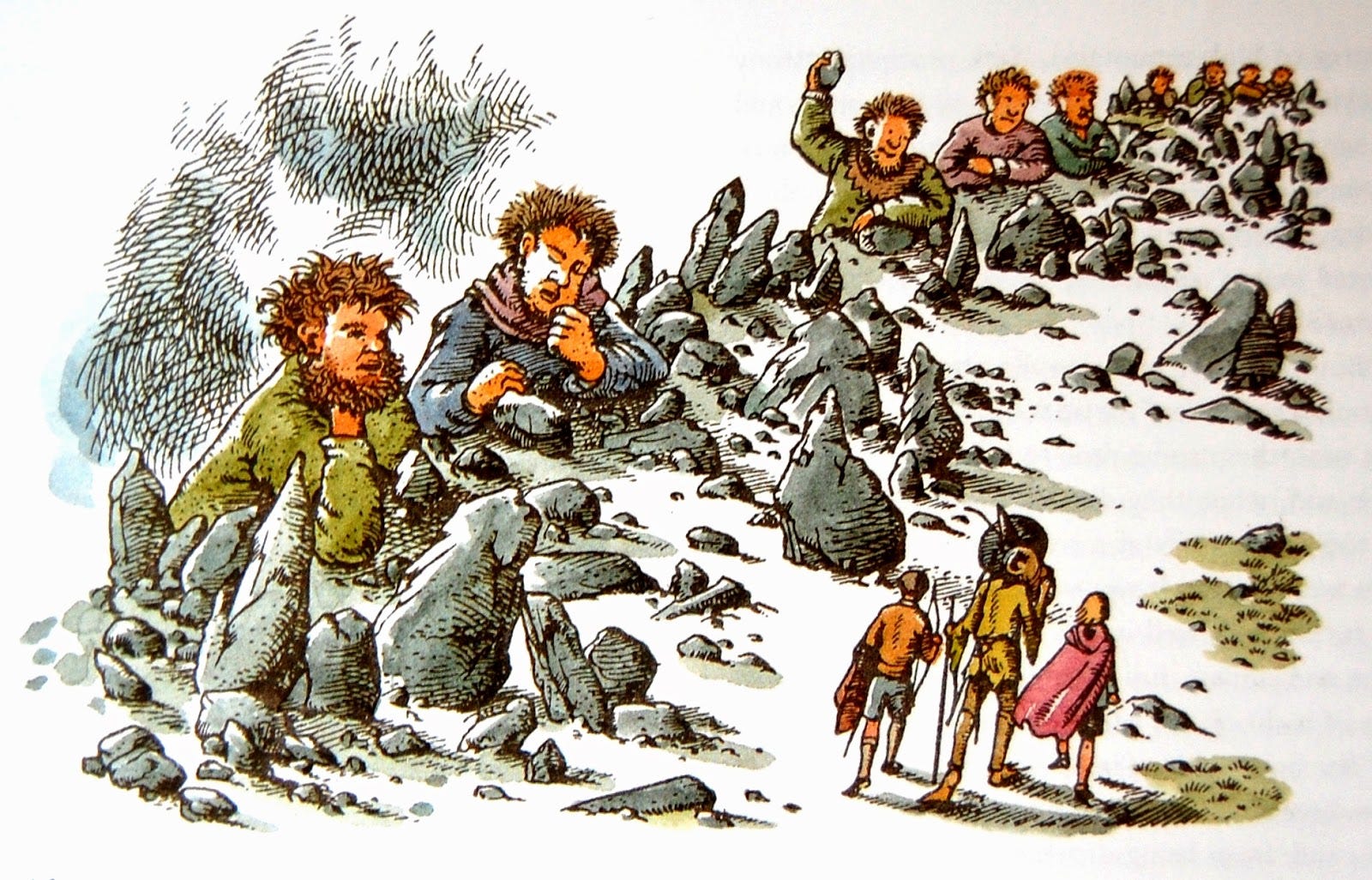
‘Suddenly she skidded, slid about five feet, and found herself to her horror sliding down into a dark, narrow chasm which seemed that moment to have appeared in front of her. Half a second later she had reached the bottom. She appeared to be in a kind of trench or groove, only about three feet wide. And though she was shaken by the fall, almost the first thing she noticed was the relief of being out of the wind; for the walls of the trench rose high above her.’
—
‘Why, you chump!’ said Scrubb. ‘We did see it. We got into the lettering. Don't you see? We got into the letter E in ME. That was your sunk lane.’
The Silver Chair, C. S. Lewis
Ok, let me just start by saying these are not particularly good quotes. But when I was thinking about children’s books that have made a huge impression on me over the years, this episode from The Silver Chair stands out. Two children - Jill and Eustace - are on a quest to rescue the missing Prince Rilian in the magical land of Narnia. At one point during this difficult journey, they fall into some sunken trenches. The next day, looking down from the lofty palace of giants at the landscape they traversed the night before, the children realise the trenches they were stuck in are in fact giant letters: letters that spell out the next clue in their quest; the words UNDER ME.
I found this scene chilling as a child, and it still haunts me. But why? Perhaps it’s the idea of blindly wandering around inside the answer to your own problem that feels terrifying. Or perhaps there’s a hopeful reading: maybe it’s a metaphor for the importance of perspective; of stepping back from a crisis before you can understand it. Or none of the above - perhaps it’s just good storytelling. And although C.S. Lewis’s books sometimes get a hard rap for their Christian symbolism in our atheist age, I do think that mostly they are strange, enthralling and unpredictable, rather than didactic.
—
Further reading on perspective and finding answers within:
‘Perhaps I’m mad - and the professor, too - but I think children must lead big lives… if it is in them to do so. And it is in Maia.’
Journey to the River Sea, Eva Ibbotson
Another modern classic, Ibbotson’s novel about an orphan girl who gets sent to live with distant relatives on the shores of the Amazon River was one of my favourites growing up. It’s a book that staunchly resists moralising until the very end - it’s just fast-paced, vividly drawn adventure until this closing speech, in which Maia’s governess is trying to convince the English authorities to let Maia return to her technicolour life in Brazil. And because Ibbotson has so admirably resisted sentimentality throughout, this last bit always floors me. Children do deserve big lives. They also deserve good books; filled with rich, daring, dangerously imaginative ideas. We deserve big lives as adults, too. And often, it’s children’s books that help me remember just how big my life can be.
For further reading on big lives and their consequences:


Thanks for reading Fictional Therapy! Do you have a problem that you’d like me to answer? Parenting crisis, romantic difficulty, work drama? Write to me here. Your submission is anonymous, even to me.
Looking for more brilliant children’s book recommendations? Pandora Sykes has just published a list of books for younger readers, from classic to contemporary.
I’m spending much of this year reading children’s books because I want to feel that magic that is unique to them.
Thanks for this beautiful post!
The line about children's literature being distilled rather than reduced is something I wish every publisher had pinned above their desk. There's a reason the books that stay with us from childhood aren't the simple ones but the complex ones — the ones the author trusted us with because they were complex.
That Silver Chair moment stayed with me too. The best children's fiction lets us walk around inside the answer to our own question without knowing it. It gives you something your eight-year-old self feels but can't articulate, and then ten or twenty years later the understanding catches up.
Your point about bad books turning children off reading for life rather than leading them to good ones is unfortunately too true. The kids who say they don't like reading are almost always the ones who haven't found anything worth reading yet.